
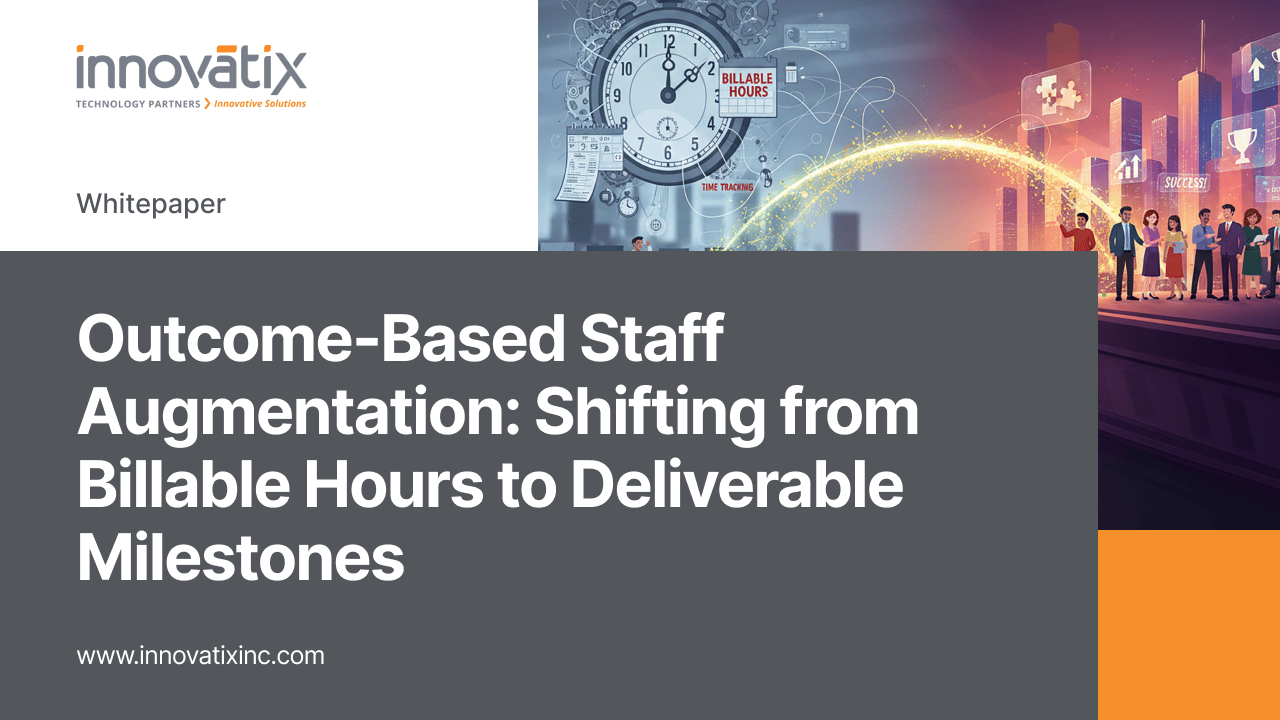
For decades, the IT industry has relied on a flawed equation: Headcount + Hours = Value. In today’s landscape of AI-assisted coding and automated CI/CD pipelines, the "Time and Materials" (T&M) model is breaking down. It creates a perverse incentive where the slower a vendor works, the more they are paid.
It is time to solve the productivity paradox of the modern tech stack.
Our latest whitepaper, "Outcome-Based Staff Augmentation: Shifting from Billable Hours to Deliverable Milestones," explores the strategic pivot toward aligning vendor incentives with your actual business goals.
In this whitepaper, you will discover:
Traditional staff augmentation places 100% of the delivery risk on the client. If the code is buggy or the project drags on, the client pays more. OBSA changes the financial and accountability structure to mirror a managed service.
By moving to a Point-Based Model or Milestone Retainer, you ensure that if a vendor uses AI to speed up, they increase their margin while you get faster delivery—a true win-win.
We provide a realistic "Crawl, Walk, Run" approach to help you transition without disrupting your entire engineering organization overnight:
"Effort does not equal impact. By aligning payment with results, we create a healthier ecosystem where vendors are motivated to be efficient, and clients pay for value."