
Case Study: Modernizing a Legacy Emergency Department Information System for a Leading Healthcare Provider
How a Leading Healthcare Provider Rebuilt Its Flagship Application Without Missing a Single Patient Intake
In an Emergency Room, software latency or failing systems is not just an IT problem… it's a patient care problem.
A top digital healthcare solutions provider had a huge operational problem with their legacy Emergency Department Information System (EDIS), which was overhauling regional hospital networks by being stuck on legacy desktop systems.
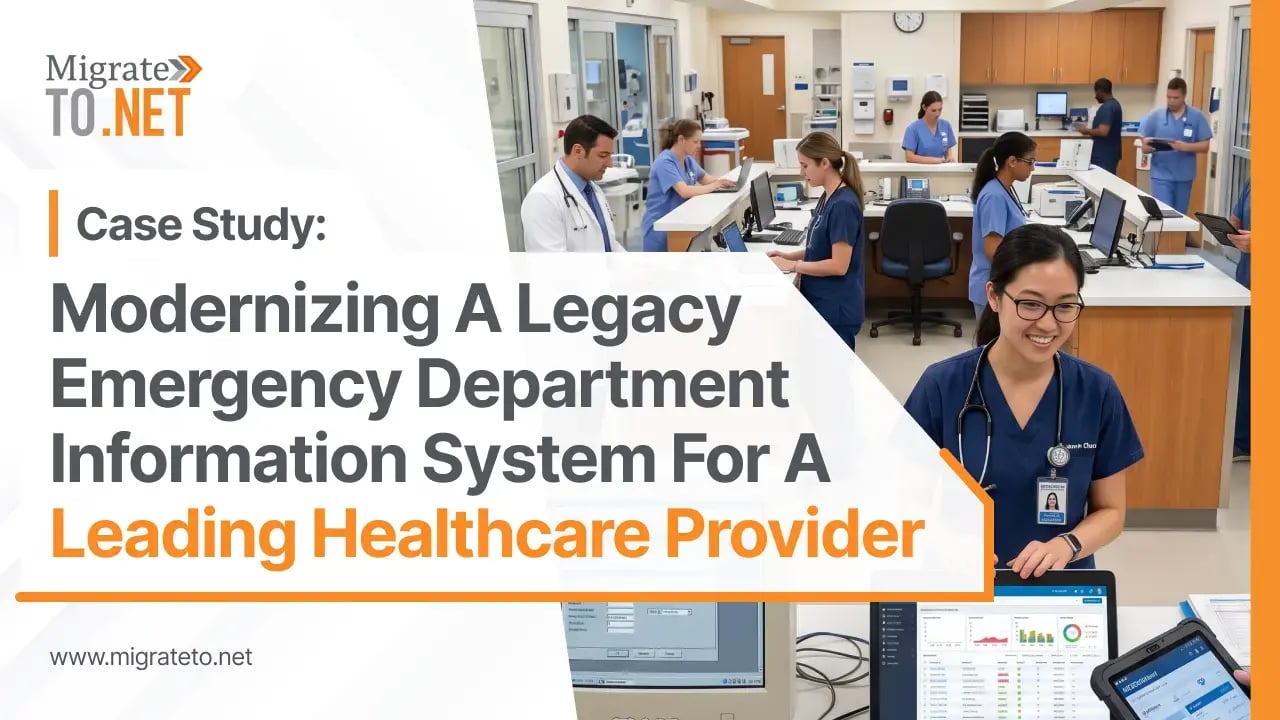
How to completely transform an existing, mission critical application without impacting clinical workflows and ongoing patient care?
Any one of these mistakes resulted in interruption of triage or delay of discharge. They had to have an air-tight plan to get from the desktop walls to web and cross-platform flexibility, without risking it.
The Challenges Holding Them Back
- The Legacy Trap: An outdated desktop system, binding clinical staff, expensive to operate and reliant on legacy OS.
- The Integration Barrier: It is extremely hard to integrate with modern interconnected healthcare frameworks and regional data streams.
- The Zero-Disruption Mandate: A specific mandate to build, test and deploy the platform with absolutely no impact on real-time ER operations.
The Strategy: A 4-Stage Blueprint
Instead of going all out and taking the risk of a "big bang" launch, a very carefully planned and staged roadmap was implemented with four distinct MVPs (Minimum Viable Products). This blueprint thoughtfully and comprehensively modernized the patient journey end-to-end:
- Phase 1: Redesigning Intake – Getting rid of the friction of the front end of the registration process.
- Phase 2: Digitalizing Triage – Clinical documentation and acuity scoring for nursing staff is automated.
- Phase 3: Synchronizing Care – Real-time Clinical Workspaces to Close Communication Gaps between Doctors and Support Staff.
- Phase 4: Modernizing Transitions – Streamlining discharge processing, external hardware feeds.
The outcome was a complete overhaul of their technical footprint, with deployments now using containers and being cloud-ready, both Windows and Linux—with no disruption to clinical operations.
Discover the Exact Blueprint
Interested in learning more about the engineering metrics, architectural decisions, and workflow improvements that enabled this to be a successful transformation?
Download the full document, "Case Study - Modernizing a Legacy Emergency Department Information System for a Leading Healthcare Provider", to uncover:
- How to roll out each of the 4 strategic MVPs – step-by-step.
- How the team handled complex hardware integration (including COM port vital sign monitors).
- The technical wins that resolved a large technical debt and paved the way for future innovations in the healthcare sector.
Download the Full Case Study today.